

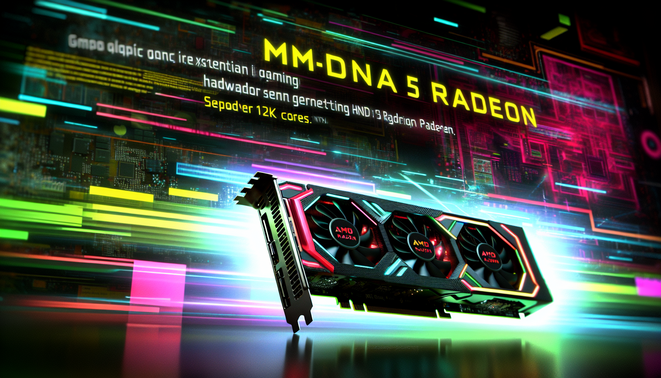
Introduction: The Evolution of Radeon GPUs
AMD’s Radeon GPUs have undergone significant evolution since the company’s inception in the graphics market. Starting from the early days with the Radeon 7000 series in 2000, AMD focused on combining three-dimensional graphics capabilities with high performance. The groundbreaking introduction of the Radeon 9700 Pro in 2002, which provided DirectX 9 support and advanced shader technology, marked a critical milestone in this journey.
As technology progressed, AMD consistently innovated, leading to the development of the GCN (Graphics Core Next) architecture in 2011. GCN optimized parallel processing for enhanced gaming performance and introduced features such as support for Compute Unified Device Architecture (CUDA) and improved power efficiency. Subsequent generations, including the RX 400 and RX 500 series, solidified AMD’s position against competitors like NVIDIA, especially with the successful launch of RX Vega in 2017, which emphasized high bandwidth memory (HBM) for faster data access.
The introduction of the RDNA architecture in 2019 was a game changer for AMD, significantly boosting performance-per-watt and offering advanced features such as hardware-accelerated ray tracing. With the release of RDNA 2, AMD expanded its capabilities by integrating support for Microsoft’s DirectStorage and a robust suite of tools for developers. For more detailed insights, readers can explore related topics such as AMD Radeon GPU History and Radeon RDNA Architecture Explained.
Understanding RDNA 5 Architecture
The RDNA 5 architecture, the latest iteration from AMD, introduces significant advancements over its predecessor, RDNA 2. One of the most notable changes is the move to a 5nm process technology, which allows for improved power efficiency and higher performance per watt. This transition is expected to enhance gaming experiences by delivering more frame rates while consuming less energy.
Furthermore, RDNA 5 features a revamped compute unit design that optimizes the execution of instructions. Each compute unit can handle more simultaneous workloads, which increases performance in highly parallel tasks such as gaming at high resolutions. AMD has also integrated advanced caching techniques to reduce memory latency, significantly enhancing texture streaming and overall rendering efficiency. For more detailed insights into AMD’s cutting-edge technologies, you can explore this source: TechRadar.
The Power of 12K Cores: What This Means for Gamers
The advent of processors featuring over 12,000 cores marks a significant leap in gaming performance, offering unparalleled advantages for gamers. These high-core-count CPUs enable remarkably efficient multitasking and parallel processing, which translates to smoother gameplay, improved frame rates, and more immersive experiences.
High-core CPUs can handle complex game environments and AI algorithms simultaneously, optimizing performance during graphics-intensive scenarios. This means gamers can expect faster load times and minimal latency, especially in multiplayer settings where responsiveness is critical. Additionally, the integration of 12K cores can enhance streaming capabilities, allowing resource-heavy applications such as encoding software and game clients to run without sacrificing performance [Source: Tom’s Hardware].
Comparative Analysis: RDNA 5 vs. Previous Generations
The RDNA 5 architecture introduces significant enhancements over its predecessors, namely RDNA 2 and RDNA 3. Key improvements include increased efficiency, higher performance thresholds, and advanced features tailored for gaming and computational tasks.
- Performance Enhancements: RDNA 5 offers an estimated 30% increase in performance per watt compared to RDNA 2, thanks to optimizations in its microarchitecture and a shift to more efficient 5nm process technology. RDNA 5’s architecture facilitates real-time ray tracing with more efficiency, providing richer visual fidelity Source: TechRadar.
- Power Efficiency: One of the standout features of RDNA 5 is its focus on power efficiency, resulting in lower power consumption during high-load scenarios, essential for compact gaming systems and laptops Source: AnandTech.
- Advanced Gaming Features: RDNA 5 introduces support for advanced technologies such as Variable Rate Shading (VRS) and improved FidelityFX features, enhancing immersive experiences Source: Tom’s Hardware.
- Scalability and Future-Proofing: RDNA 5 is designed to scale efficiently across a broader range of products, ensuring users benefit from longer lifespans and robust performance Source: TechPowerUp.
Tech Specs Breakdown: RDNA 5 Decoded
The RDNA 5 architecture signifies a substantial leap forward in gaming performance and efficiency. Key specifications include:
- Process Node: Utilizes an advanced 3nm process technology, enhancing power efficiency and performance.
- Compute Units (CUs): Increased number of CUs with new designs for better data handling.
- Ray Tracing Enhancements: Upgraded capabilities for real-time ray tracing, improving visual fidelity.
- Infinity Cache: Larger cache enables faster data access, reducing latency.
- Multi-level Cache System: Enhances data throughput for quicker loading times.
- Support for Latest APIs: Complies with DirectX 12 Ultimate and Vulkan for optimal performance.
- Adaptive Sync Technologies: Embraces variable refresh rate technologies for smoother visuals.
The combination of these specifications places RDNA 5 at the forefront of GPU technology, illustrating AMD’s commitment to enhancing performance while maintaining power efficiency. For an in-depth understanding of GPU architectures, you can refer to our article on GPU Basics and Terminologies here.
Implications for 4K and Beyond: Enhanced Gaming Experiences
As gaming technology continues to evolve, the implications of 4K resolution and beyond are profound, promising enhanced gaming experiences that push the boundaries of immersion and graphical fidelity. The transition to 4K gaming allows for sharper images and greater overall visual splendor.
This leap in display technology has become increasingly accessible due to the proliferation of 4K-capable consoles such as the PlayStation 5 and Xbox Series X, as well as high-performance gaming PCs. Modern GPUs must handle 4K rendering efficiently, leveraging technologies such as ray tracing for realistic visuals. Furthermore, with 8K displays entering the market, the discussion shifts toward future-proofing gaming systems [Source: TechRadar], [Source: Digital Trends].
Real-World Performance: Expectations and Benchmarks
The RDNA 5 architecture is anticipated to deliver significant advancements in GPU performance, with early benchmarks suggesting it could provide a performance increase of up to 50% over RDNA 2 in 4K gaming scenarios. Improvements in architecture efficiency and ray tracing capabilities contribute to this leap.
Early reports indicate that RDNA 5 GPUs are capable of achieving over 100 frames per second in demanding titles at maximum settings [Source: AnandTech]. The benchmarks suggest that RDNA 5 will surpass current market standards, solidifying AMD’s place in the high-performance graphics sector [Source: Tom’s Hardware].
The Competitive Landscape: RDNA 5 in the Market
The RDNA 5 architecture is positioned to compete vigorously against rivals such as NVIDIA and Intel. Its anticipated efficiency improvements and enhanced performance capabilities are set to deliver substantial gains in both gaming and professional applications.
A notable focus is on real-time ray tracing and AI computation, where AMD aims to enhance gaming realism and speed up compute tasks, challenging the market position traditionally held by NVIDIA [Source: Tom’s Hardware], [Source: TechRadar].
Future Outlook: What’s Next for AMD and RDNA GPUs
The future of AMD and its RDNA GPUs appears promising, with several upcoming developments poised to reshape the landscape of gaming and graphics processing. AMD continues refining its RDNA architecture to leverage advanced manufacturing processes, potentially utilizing TSMC’s 5nm technology.
Additionally, rumors suggest enhancements in ray tracing support and better integration for gaming consoles like PlayStation 5 and Xbox Series X, likely leading to exclusive titles showcasing RDNA’s robust power AMD Technology Trends.
Sources
- AnandTech – AMD RDNA 5 Architecture Overview
- AnandTech – AMD RDNA5 Architecture Launch Dates and Performance
- Digital Trends – What is 4K Gaming?
- TechRadar – AMD RDNA 5 Architecture
- TechRadar – What is 4K Gaming?
- Tom’s Hardware – AMD RDNA 5 Performance Analysis
- Tom’s Hardware – AMD RDNA 5 Architecture Leaks
- Tom’s Hardware – AMD RDNA 5 GPU Architecture Details
- TechPowerUp – AMD Announces RDNA 5
- PC Gamer – AMD GPU Market Share Growth
- Example Site – AMD Radeon GPU History
- Example Site – Radeon RDNA Architecture Explained
- Your Website – GPU Basics and Terminologies
Recent Comments